Failing Faster: The Counterintuitive Path to Elite Performance
A Transformational Conversation with Coach Alejandro Macario and Jordan Dunin
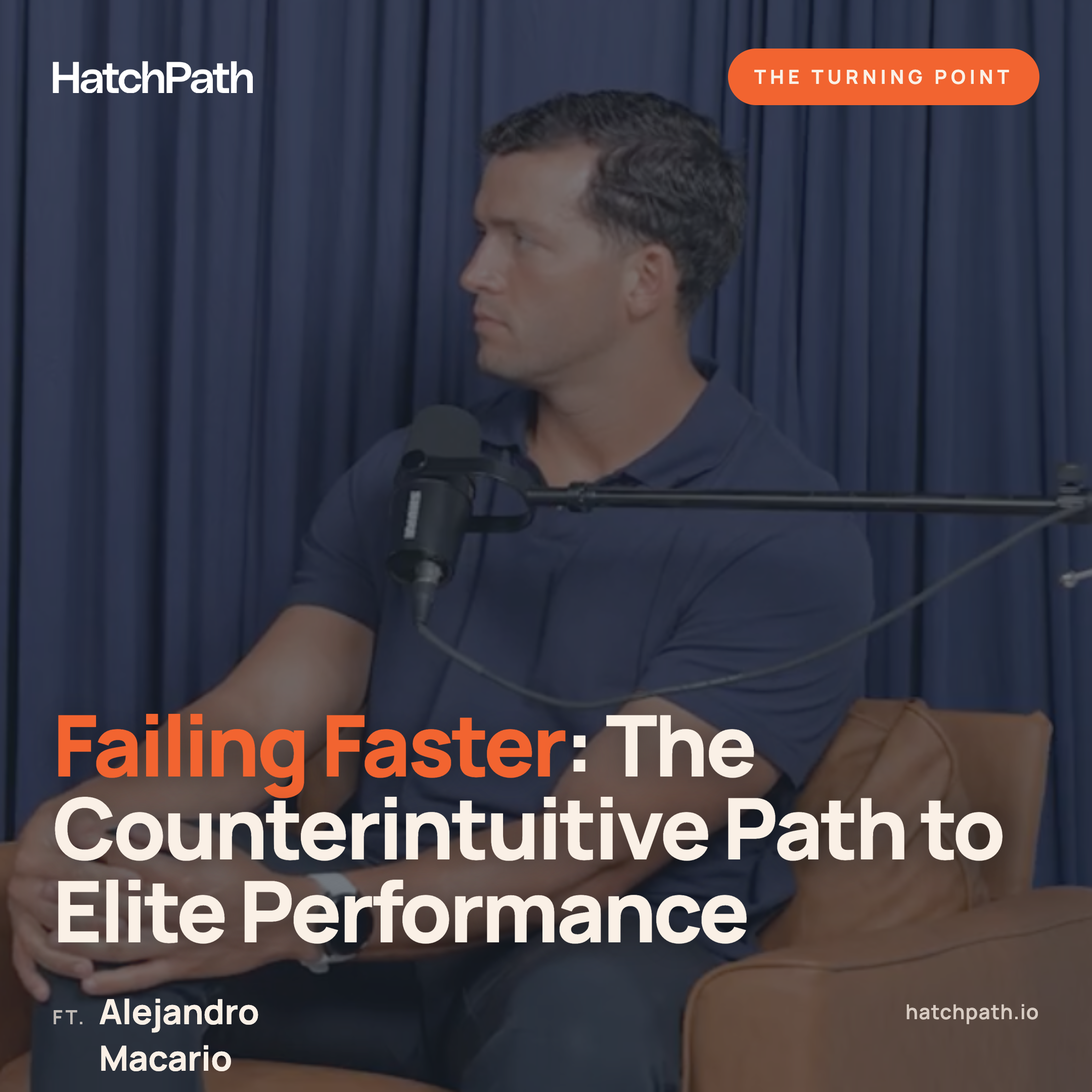

Alejandro Macario
High Performance Coach · Mental Performance Coach, Baltimore Orioles · HatchPath
🎙️ Listen to the Full Episode
🎬 Watch the Full Episode
Most people spend their careers trying to avoid failure. Elite performers run toward it. In this episode of Transformational Conversations, Jordan Dunin sits down with Alejandro Macario, High Performance and Mental Skills Coach and Mental Performance Coach for the Baltimore Orioles, to unpack one of the most counterintuitive ideas in high performance: failing faster is the fastest path to growth. Alejandro works inside an environment where focus, composure, and confidence have to show up on demand, across a big-league season with slumps, setbacks, and constant evaluation baked into the job. With a Master's degree in Sports, Exercise and Performance Psychology, he trains the brain and nervous system the same way elite performers train their bodies, so that high-stakes moments become something you prepare for rather than something that happens to you.
An Elite Mindset Is Trained, Not Inherited
The conversation starts with a reframe that changes how the rest of it lands. An elite mindset is not a personality trait that some people are born with and others are not. It is a trainable skill, built the same way any physical skill is built: through repetition, feedback, and adjustment. What separates elite performers is not the absence of mistakes, it is the consistency of the process they return to when pressure arrives.
An elite mindset is a trainable skill, not a personality trait. The core of it is the ability to run your process regardless of the outcome, the pressure, or the noise around you.
That distinction matters for anyone who is not a professional athlete. If composure is a skill, it can be practiced on a Tuesday afternoon before the meeting that matters, rather than summoned in the moment it is needed. Alejandro's work with players is essentially preparation work: building routines and regulation habits in calm conditions so the nervous system has something familiar to reach for when conditions stop being calm.
Failing Faster: Failure as Data, Not Identity
Inside the Orioles organization, the language is deliberate: fail quicker, go higher. The staff encourages early failure because early failure produces information sooner. Every mistake is a data point about what needs adjusting, and the earlier those data points arrive, the earlier the adjustments can start compounding.
The trap most people fall into is treating failure as identity rather than information. When a mistake becomes evidence about who you are, the instinct is to avoid the next opportunity to make one. When a mistake stays a data point, the instinct is to go find the next adjustment.
Failure is not an end state, it is a chance to reflect and adjust. The real failure is not making the adjustment after the mistake, which leaves the same blind spot in place.
The Breathwork Reset for High-Stakes Moments
When the stakes rise, the first tool Alejandro reaches for is the simplest one. Mental and physical states are intertwined, and the breath is the most direct bridge between them. His reset is a set of deep breaths with a longer exhale than inhale, which activates the parasympathetic nervous system and brings the body out of reactivity.
This is where the episode connects directly to the foundation of everything HatchPath does. A dysregulated nervous system cannot perform, and a trained one can do almost anything. Regulate first, then perform. The breath is the fastest available route back to a state where your best output is actually accessible.
Rewire the Patterns That Quietly Limit Performance
Alejandro's work is not only about the big moments. It is also about the small, repeating patterns that quietly cap performance long before anyone notices them. These are the habits that feel like personality but are actually trainable:
- Overthinking: rehearsing a moment so many times that attention never lands on the moment itself
- Inconsistent routines: showing up differently every day, which makes performance unpredictable
- Negative self-talk: commentary that turns a mistake into a verdict about identity
- Stress reactivity: a nervous system that fires first and thinks second, no matter how much you know better
None of these are fixed traits. Each is a pattern that can be observed, challenged, and replaced with a new reference point the nervous system learns to trust. That is the practical meaning of mental training: not positive thinking, but rewiring what your body does automatically under load.
Attention Control: Composure Is Built in Practice
Elite performers do not control the crowd, the scoreboard, or the outcome. What they can control is where their attention goes next. The pressure routines Alejandro builds with athletes are attention routines: a consistent sequence that narrows focus back to the next pitch, the next possession, the next play, instead of letting attention drift to consequences that have not happened yet.
Composure under pressure is not discovered in the moment. It is built in practice, then borrowed when the moment arrives.
The same principle holds in a boardroom, a difficult conversation, or a performance review. You cannot decide to be composed at the exact second composure is required. You can rehearse a routine that makes it available.
Values-Based Goals: Sustainable Instead of Obsessive
The final layer is the one that keeps high performance from becoming self-destructive. Alejandro works with values-based goal setting, where the goals are anchored to what a person actually cares about rather than to an external scoreboard alone. When goals are connected to values, effort stays sustainable. When they are anchored only to outcomes, performance tips into obsession, and the same drive that produced results starts eroding the person producing them.
For leaders and teams, that distinction is often the difference between a strong quarter and a burned-out year. High standards are not the risk. High standards with no grounding outside the scoreboard are.
The Mental Toolkit: What to Do Next
- Pick one routine you can return to when pressure hits, and rehearse it before you need it
- Shorten the loop between mistake and adjustment: name one change the same day, not next week
- Practice the breathwork reset, deep breaths with a longer exhale, so it becomes automatic under pressure
- Audit the patterns that cap you: overthinking, inconsistent routines, self-talk, and reactivity are all trainable
- Set goals against your values, not just against outcomes, so performance stays sustainable
- Listen to the full episode on the HatchPath podcast, or watch it on YouTube
- HatchPath members: book a 1:1 session with Alejandro through the Member Hub to build the mental system for your goals
- Non-members: contact your employer about HatchPath membership
Alejandro Macario is a High Performance Coach and the Mental Performance Coach for the Baltimore Orioles, with a Master's in Sports, Exercise and Performance Psychology. He works with HatchPath members on building the elite mindset, mental skills, and real-time regulation that high performance actually requires.