Leading Through Change: Kara Down on Heart Health, High Performance, and Making Stuff Happen
A HatchPath Summit Conversation with Kara Down and Jordan Dunin
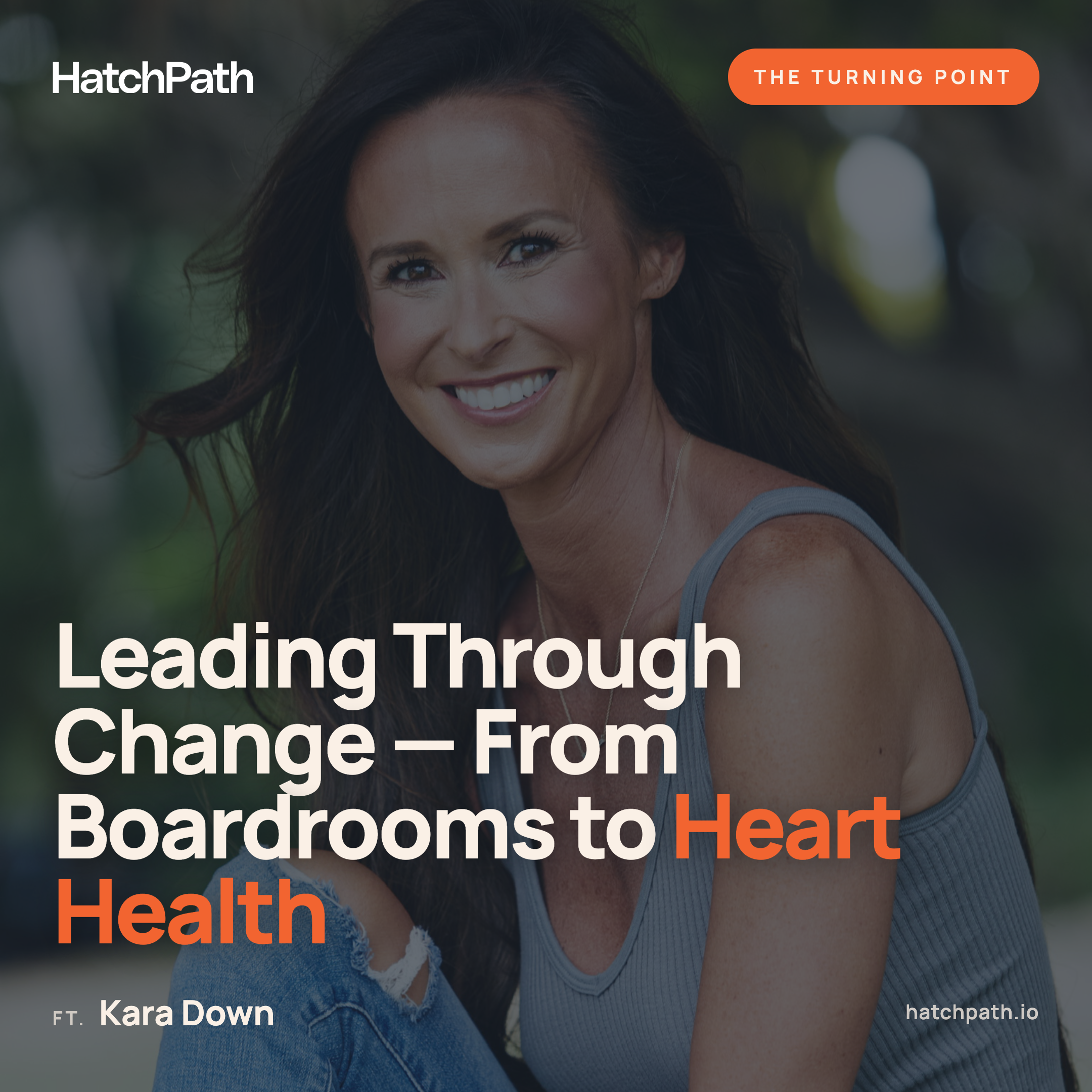
Kara Down
Administrative Director of Executive Initiatives, Naples Comprehensive Health
🎙️ Listen to the Full Episode
Kara Down has spent her career moving between industries, and the through line has never been the industry. It has been her. She is the Administrative Director of Executive Initiatives at Naples Comprehensive Health in Naples, Florida, where she works alongside the health system's president and CEO in the leadership of the NCH Heart Institute. Before that: media relations at HCA in Nashville, managing press and marketing for a network of 151 hospitals, mergers and acquisitions at Wachovia, cross departmental projects at Wells Fargo, and a decade as a principal consultant with NTT Data advising clients like PayPal, Venmo, and Bank of America. She is also a fitness instructor, a personal trainer, a mom of two, and an active volunteer with the American Heart Association in Southwest Florida. In this HatchPath summit, she sat down with Jordan Dunin to talk about health as the foundation of performance, what burnout actually cost her, and the 30 minutes a day she asks of everybody.
Health and Wellness Has to Come First, Even in Healthcare
Kara opens with the principle everything else in the conversation rests on: our health and wellness drives everything we do, and it has to come first, whether or not you work in healthcare. Then she names the irony at the center of her own industry. People in healthcare often take less care of themselves, because they are so busy taking care of others.
She layers a second pattern on top of it, the one she describes as being a woman and especially a mom: putting other people first and yourself last on the totem pole. Her response is deliberate. She works to remove the stigma that taking time for yourself is selfish, and she is honest about the seasons when it slips, when you cannot move as much as you would like or eat as well as you might want.
That honesty is the practical part. Rather than getting down on yourself in those seasons, the question becomes how you can do better in the next steps forward. Kara thinks of it as a tripod: what you put into your body, what you do in terms of activity, and a third leg she describes as being gracious with yourself. It may not be everything, it may be a beverage of choice, it may be food, it may be movement. Whatever you can do, and the mental capacity follows.
"It has always been really important for me to remove any stigma around it being selfish that you take time for yourself and prioritize health and wellness." Kara Down
She adds the cultural piece, the one she and Jordan both came back to: it is easy to define what is wrong with where you are, and leading with a glass half full approach makes everybody around you happier. Her version is simple. It is a lot harder to be unkind than it is to be kind.
Standards, Not Routines
Jordan introduced a distinction he uses in his own life: he avoids routines and sets standards instead, standards for how he shows up at work, standards for how he shows up for his kids. When he is heading toward burnout, his tell is that his standards quietly disappear and he starts reaching, whether that is a craving for pizza night or ice cream. He asked Kara whether she has seen the same thing.
She has, and she pointed to where it shows up most in modern life: the forward facing culture of social media, where we get caught up in the success of others and start downplaying our own. Her countermeasure is to keep standards of her own and sometimes to take space away from social entirely, remembering that what goes on the camera is not always reality. As someone with a production background, she says she understands that better than most.
The Bank Years: What Burnout Actually Looked Like
Kara can point to the exact season when her own standards fell furthest away from her. It was the financial crisis, 2008 and 2009, when everyone was losing homes and foreclosures and bankruptcies were rampant. Those were the projects she was working on, without knowing personally any of the tens of thousands of people the cases were for.
The workload kept growing. At one point she was managing 21 projects by herself with one part time coordinator helping her. A friend asked whether she had ever thought about consulting, where she could work on one piece of a project and have a far better work life balance. It took her about a year and a half to say yes. The second she did, her life changed: she went back into personal training and fitness modeling, she still worked from home and stayed a full time mom, and she had time to be a room mom and remember what was truly important.
There is one detail in the story that settles the question of whether she was imagining the burnout. When she left, they replaced her with three people.
"I did not want to view it as failure that I was giving up. But it was really giving myself a new life and a new lease on life, a new outlook." Kara Down
Move 30 Minutes a Day, and Leave Your Phone Behind
Because of her fitness background, Kara gets the same question in the hallways of the hospital all the time: what should I do, or what am I doing wrong. Her mantra is always the same. Do something that is achievable for you, because that looks different for everybody. At bare minimum, her recommendation is to move for 30 minutes a day.
Then she layers on the conditions that make those 30 minutes worth more. If you can do it without your phone, it is even better, because you remove the distraction and separate yourself. If you can do it outside, better still, because of the grounding effect. It can be a walk around the neighborhood, walking the dog, a park, or the halls of the hospital. It can be stretching, a walk, a jog, a treadmill. And it does not have to be every day. Two to three times a week is a real goal if that is what is achievable for you right now.
Her framing for the objection she hears most is the one that tends to land. We do not think twice about a 30 minute drive to the office. So why can we not find 30 minutes to walk around it?
"Do something that is achievable for you. But at bare minimum, move for 30 minutes a day. And if you can do it without your phone, it is even better, because you need to separate your brain from whatever it is that you are addicted to." Kara Down
Her own movement looks different every day, because her time is different every day: some days a vibration plate, some days the reformer for something stretching and challenging, some days a walk or a run around the neighborhood. The consistency is in the standard, not the format. And when you make it a priority, she says, it really does change the landscape of your day or your week.
Wellbeing Is a Performance Strategy
Jordan pushed the conversation past the idea of wellbeing as a nice to have, and Kara agreed completely. Health and wellbeing is tied to performance. Her observation is that the highest performers are often former athletes at their core, and she was one, a competitive runner and a cheerleader through college. What athletes bring into the workplace is not just discipline but a set of habits: they know how to take care of their bodies, they know how to work on teams, and they listen.
She sees the same dynamic in the clinical side of her own organization. Providers who take care of themselves often perform better in the operating room and with patients, because they are not telling a patient one thing while doing the other. And she flagged how much that has shifted since the 1970s and 1980s, when healthcare workers would step outside for a cigarette between patients. Today she sees walks, meditation, and time on recovery tools instead, a culture of pouring back into yourself.
"Health and wellness is tied to performance. Those who take care of themselves often perform better in the operating room or with patients, because they are not being the hypocritical doctor telling you something but doing the other." Kara Down
For context, Jordan shared the number he keeps coming back to: only about seven percent of people in the United States are metabolically healthy. That is the baseline Kara wants us moving, and the reason she is unapologetic about repeating the same simple prescription.
Recovery Is Not Secondary
One of the sharpest threads in the conversation was recovery. Jordan pointed out that professional athletes have recovery written into their contracts, to the point where sleep is protected, and that the difference between an athlete training and the rest of us training is that the athlete has time to recover afterward while everyone else goes straight to work, family, and bills. Recovery, he argued, is another word for wellbeing or longevity, and somewhere along the way we were taught that it is optional.
Kara's answer was direct. Rest is just as important as being active, and you have to rest in order to keep being active. When she was training heavily, a day off was not a luxury or a lapse, it was part of the program, sometimes more than one day depending on what she was doing and the season of life she was in. The rule she offers everybody else is the same one, and it scales down. Even 30 minutes of rest counts.
"Rest is just as important as being active. You have to rest in order to be able to continue being active." Kara Down
The Work: Inside the NCH Heart Institute
Kara's day job sits at the intersection of strategy, culture, and storytelling. In her role at Naples Comprehensive Health, she supports the president and CEO on the executive initiatives he wants to bring to life across the system, which means work in strategy, communications, culture, and branding, along with telling the patient stories that show what community healthcare can actually do. The calls she loves most are the ones that start with somebody saying they have a patient they want her to come meet.
A large share of those calls come from the Heart Institute. She arrived about a month after the president of the Heart Institute did, five and a half years ago, and has watched the program grow from a small effort into a world renowned one. Last year they were doing around 300 open heart cases. This calendar year they will do roughly 1,300, which Jordan translated on the spot to nearly four a day. Many of those are now minimally invasive, with patients going home in 48 hours.
The next chapter is a state of the art heart institute opening next fall, where the team will perform LVADs and eventually heart transplants, in Naples. As Kara put it, an unbelievable number of lives are being changed in a small town.
The American Heart Association and Woman of Impact
Kara's involvement with the American Heart Association came through her work at NCH, after a call from Jessica Rodriguez at the Heart Association who had been talking with a Southwest Florida news reporter about nominating her as a Woman of Impact. Kara went to coffee to hear what it involved, and said yes.
That nine week campaign changed what she understood about her own health. Five and a half years ago, she did not know half of what she knows today about heart disease, especially in women. She came within about a thousand dollars of winning, and raised more than 25,000 dollars for awareness and research along the way. What she learned in the process is the fact she repeats now: heart disease is the number one killer of women, and women do not do enough to take care of themselves.
The relationship between NCH and the Heart Association has kept growing since. The health system is the first in the United States to offer a tool that, in about 30 seconds, uses AI to estimate a patient's predetermined risk of heart disease and heart failure as they age. Close to 15 percent of the patients who have gone through that VIP program have had immediate procedures following, catching issues they otherwise would not have known about. Kara noted there is an open heart case the day after this conversation, for exactly that kind of patient.
Beyond the technology, the two organizations run community panel discussions with top doctors and nurse practitioners, and the health system's chief operating officer is chairing the Heart Ball this year. It is mission tying, in Kara's words, and a no brainer for her to stay involved. She has spent the years since pulling friends and colleagues in behind it, Jordan included.
"I learned that it is the number one killer of women. And I guess I said this at the beginning: we do not do enough to take care of ourselves as women." Kara Down
Rapid Fire
- Morning routine or night owl: a split, depending on what is going on
- Books or podcasts: a die hard book girl, though podcasts have become part of the commute
- Hidden gem in Naples: Maria's Tacos y Mas, right across from Mercado. Order yours with melted cheese
- Best advice ever received: lead by listening. You cannot go far as a leader unless you listen to the people around you, and alone you are just one person
- A belief she reversed: that she had to do it all alone. Asking for help is not a weakness, it is a strength, and other people want the chance to help
- For the next generation of women leading in healthcare: have a high sense of accountability. Her mantra is MSH, make stuff happen. Believe you are just as equipped as the next person, regardless of what your paycheck says, and prove yourself every single day
What to Do Next
- Move for 30 minutes today, and leave your phone behind while you do it
- Pick the one leg of the tripod you can actually control this week: what you put in your body, how you move, or how you speak to yourself
- Set a standard instead of a routine, and notice which one disappears first when you are heading toward burnout
- Protect the rest the same way you protect the work, even if it is 30 minutes of it
- Know your heart risk. Ask about risk assessment at your next visit, and if you are in Southwest Florida, look into the NCH Heart Institute's screening programs
- HatchPath members: listen to the full conversation in the Member Hub, and book a concierge call to be matched with a coach who can help you build a plan around your own standards
Kara Down is the Administrative Director of Executive Initiatives at Naples Comprehensive Health, where she works alongside the leadership of the NCH Heart Institute, and an active volunteer with the American Heart Association in Southwest Florida. This conversation is part of the HatchPath Transformational Conversations series. Book a free concierge call to be matched with a coach who can help you build sustainable performance, recovery, and heart health into the way you work.
About the Author
Kara Down
Administrative Director of Executive Initiatives, Naples Comprehensive Health