Out of Survival Mode: Klaudia Balogh on Why Nervous System Regulation Is the Missing Link
A Transformational Conversation with Longevity Journalist Klaudia Balogh
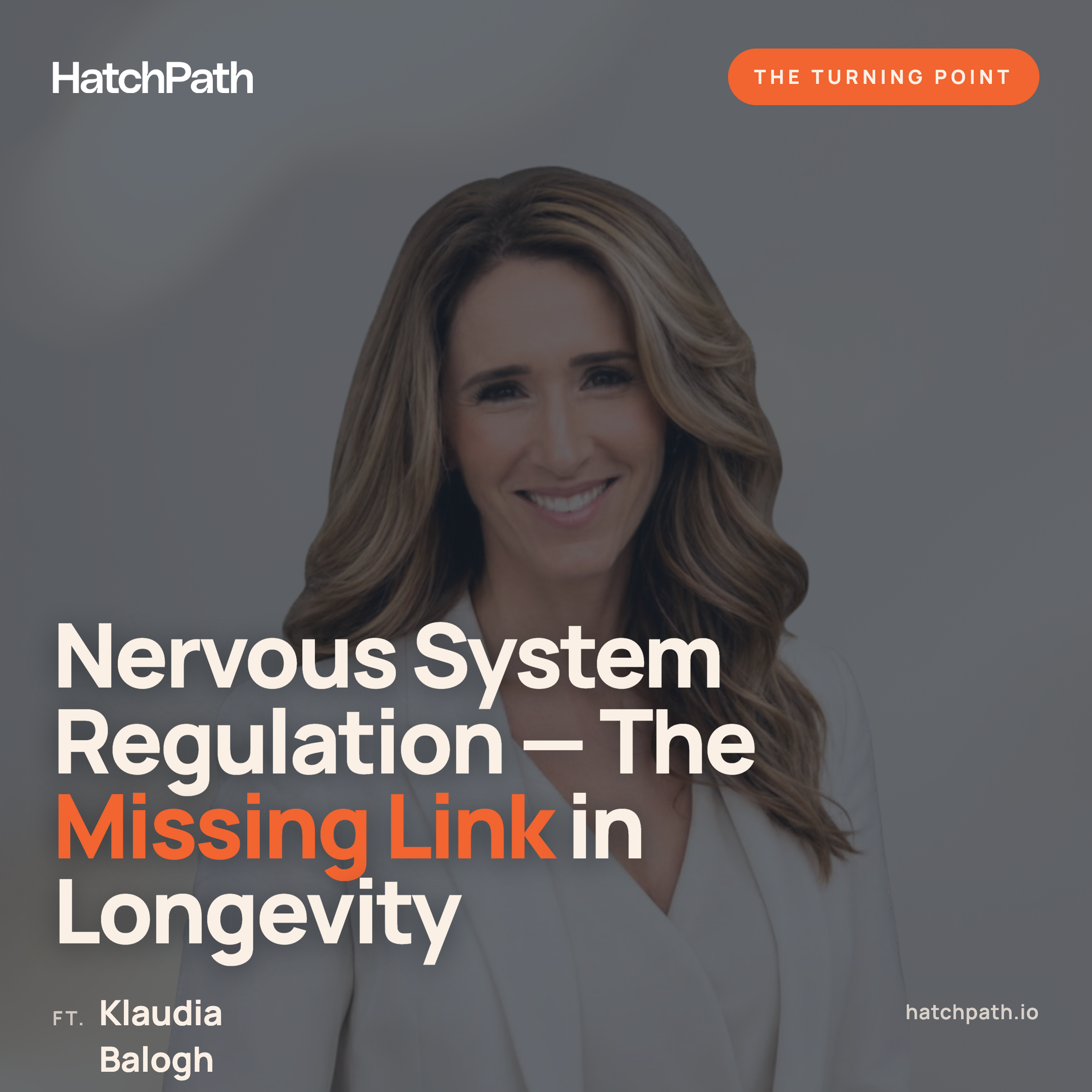
Klaudia Balogh
Health & Longevity Journalist · Co-host, 90% Healthy Podcast
🎙️ Listen to the Full Episode
There is a version of the longevity conversation that is all sleep trackers, cold plunges, and supplements. Then there is the version Klaudia Balogh and Jordan Dunin record here. Klaudia is a health and longevity journalist with more than 15 years of international reporting experience, and in this Transformational Conversation she makes the case that the missing link is not another protocol. It is the state of your nervous system. You can optimize your sleep, your nutrition, and every longevity protocol on the market, and if your nervous system is stuck in survival mode, none of it holds.
The Two Branches of Your Nervous System
Klaudia starts with the basics, because most people have never had them explained. Your nervous system runs on two branches. The sympathetic branch is fight or flight: the state that historically drove us away from threat and toward food, prey, and shelter. The parasympathetic branch is rest and digest: the state where the body recovers, recharges, and rebalances the stress hormones that were elevated while you were fighting or fleeing.
The two are meant to work in balance, like a tug of war. You are supposed to have periods of sympathetic activation and periods of parasympathetic recovery. That back and forth is what builds resilience. The problem is not that the gas pedal exists. The problem is staying on it.
"You're supposed to have periods of sympathetic and periods of parasympathetic. As long as it's in balance, your body is building resilience. The problem occurs when your nervous system goes out of balance and you're spending too much time on that gas pedal." Klaudia Balogh
Resilience Is Not the Same as Depletion
One of the most useful reframes in the conversation is what resilience actually means. In popular culture, resilience has come to look like depletion: four hours of sleep, a cold plunge at dawn, twenty hour workdays. Jordan pushes back on that directly, arguing that what we call resilience is often just a depletion story. It may be survivable in your twenties. It is not a strategy for a life.
Klaudia's warning is that the traits which create early success, intensity, consistency, and a willingness to push through discomfort, are the same ones that, left unmanaged, accelerate the decline they were meant to prevent. The fix is not to stop pushing. It is to pair the push with the same discipline applied to slowing down on purpose.
What Chronic Cortisol Actually Does
The conversation gets specific about the biology, and Klaudia is careful with her language. Acute cortisol is not the enemy. When you are reaching for a goal or in a moment that demands a higher gear, cortisol upregulates memory and sharpens attention. That is what it is designed to do.
The problem is chronic elevation. When cortisol stays high, it crosses the blood brain barrier, dampens the hippocampus and the hypothalamus, the regions involved in regulating mood and behavior, and upregulates the amygdala, the primal, hyper vigilant part of the brain. The result is the opposite of performance: an anxious baseline you cannot switch off.
"Short term, cortisol is good for you because it helps you perform better. Chronically elevated, it does the opposite. It dampens the regions that keep you balanced and upregulates the one that keeps you on alert." Klaudia Balogh
Jordan adds the frame that makes it stick: the poison is in the dose. Too much water is not better than enough water, and a little of a good thing is not improved by a lot of it.
Why This Shows Up in How You Age
Klaudia is deliberate about not overclaiming. The research she has been reading shows a correlation, not causation, between chronically elevated stress hormones and changes in gene expression. There are no longitudinal human studies that prove the full chain.
What she takes from it is still worth acting on. Sustained sympathetic activation appears to be correlated with how your genes express themselves over time, including how well your body responds to viral, bacterial, and other pathogens as you age. Which is why the argument that you can push hard now and recover later does not hold up. You are shaping the body that has to live with that decision.
The good news is that those epigenetic changes are not permanent. They have been shown to reverse. The catch is time. Genes do not switch on and off in a heartbeat.
The Ego Is What Holds the Gas Pedal Down
Klaudia is candid about her own version of this. The ego hates missing out. It wants to be where everything is happening, in the room, connected, in front of people. She goes from conference to event to conference because it is genuinely exciting and genuinely connecting, and she notices the cost: she is depleted for a week afterward because her body has been through one extended stress response after another.
The cultural version of the same pattern is hustle culture, the idea that you spend your twenties grinding so you can enjoy the rest of your life later. Jordan points to the contradiction underneath it. Why work so hard for a life you could choose to start living today? His counter example is the European approach he grew up around, where a midday reset is not laziness. It is maintenance.
How to Get Out of Survival Mode
Klaudia's prescription is almost deliberately unglamorous, and it starts before any technique at all.
- Notice first. Awareness is the intervention that makes everything else possible. Do you feel anxious more often than you should? Are you hyper vigilant, sleeping badly, or watching your HRV trend the wrong way?
- Do not collect tools. The temptation is to get excited about every shiny new regulation hack. Klaudia's caution is that this becomes its own dopamine driver, and you end up with ten half practices and no idea which one is working.
- Learn what is evidence based. Read, listen to podcasts, and talk to the coaches and practitioners who know the space, then build a short list of modalities that actually have support behind them.
- Choose one. Pick the practice closest to you, whether that is breathwork before bed, vagus nerve stimulation on waking, or five minute micro breaks across your workday instead of one long punishing workout.
- Do it for four weeks. The body may respond in a week or two, but four weeks is enough time to see whether something has genuinely shifted.
- Then decide. Continue it, add one more thing, or swap it out. One change at a time is how you learn what your nervous system actually responds to.
"Don't jump on ten different things and try all of it at once. You don't know which one is working, which one is a waste of money and time, and whether you're responding in the way you want to." Klaudia Balogh
Doing Less Can Be Doing More
Jordan's own instinct has moved toward subtraction. Longevity, he argues, has been reduced to cold plunges, saunas, hyperbaric chambers, and IV drips, when the fundamentals are still the fundamentals: sleep, putting your phone away a couple of hours before bed, finishing eating a couple of hours before bed, and letting your body get into a downregulated state so it can actually do its work. Sleep is not recovery after performance. It is preparation for it.
His rule for himself is deliberately unambitious. If it can be done tomorrow, it can be done tomorrow. He is not anti ambition, and he is clear that not everyone has the same flexibility. His argument is that when you are deciding whether to add one more thing, doing less is often the higher return, for your health, your work, and your relationships.
The deeper point is patience. Most people did not arrive in burnout overnight, and getting out can take a year or more. Jordan rebuilt his own health after a broken neck at twenty and a chronic Lyme diagnosis, drug free and surgery free, over two and a half to three years of consistent behavior change, with nervous system regulation at the base of it. That consistency is what eventually became an identity change.
Where to Find Klaudia
Klaudia publishes under the brand Longevity Journalist on all social platforms and on LinkedIn, where she shares breakdowns of the research shaping this space. She co-hosts the 90% Healthy podcast with a sports scientist, focused on performance, recovery, and the health practices actually worth your attention.
🦾 WANT TO GO DEEPER WITH KLAUDIA?
She's hosting the first Naples Longevity Experience on Thursday, October 22, from 5 to 7 PM at OsteoStrong Naples Vanderbilt. It's a new event series bringing longevity experts and the industry's most talked about tech to Naples, and night one is all about bone health.
- Osteogenic loading
- Vibration plates
- Red light therapy
- Compression boots
- PEMF
- The BioCharger
- A live expert conversation on how to actually measure and improve bone density at almost any age
Reserve your spot with code HatchPath10 for 10% off
Space is limited.
What to Do Next
- Notice where you actually are: anxious more often than you should be, hyper vigilant, sleeping badly, or trending down on HRV
- Pick one evidence based regulation practice and commit to it for four weeks before adding anything else
- Protect the fundamentals first: sleep, a screen free wind down, and an earlier last meal
- If you are in or near Naples, look into The Longevity Experience on October 22
- HatchPath members: explore the breathwork, yoga, and regulation programs in the Member Hub, or book a session with a coach to build a plan around your own nervous system
Klaudia Balogh is a health and longevity journalist with more than 15 years of international reporting experience and co-host of the 90% Healthy podcast. This conversation is part of the HatchPath Transformational Conversations series. Book a free concierge call to be matched with a coach who can help you build a regulation and recovery plan that lasts.
About the Author
Klaudia Balogh
Health & Longevity Journalist · Co-host, 90% Healthy Podcast