Strength Without Burnout: How to Break the Push, Crash, Repeat Cycle
A HatchPath Summit Recap with Coach Alexandra Kozlowski
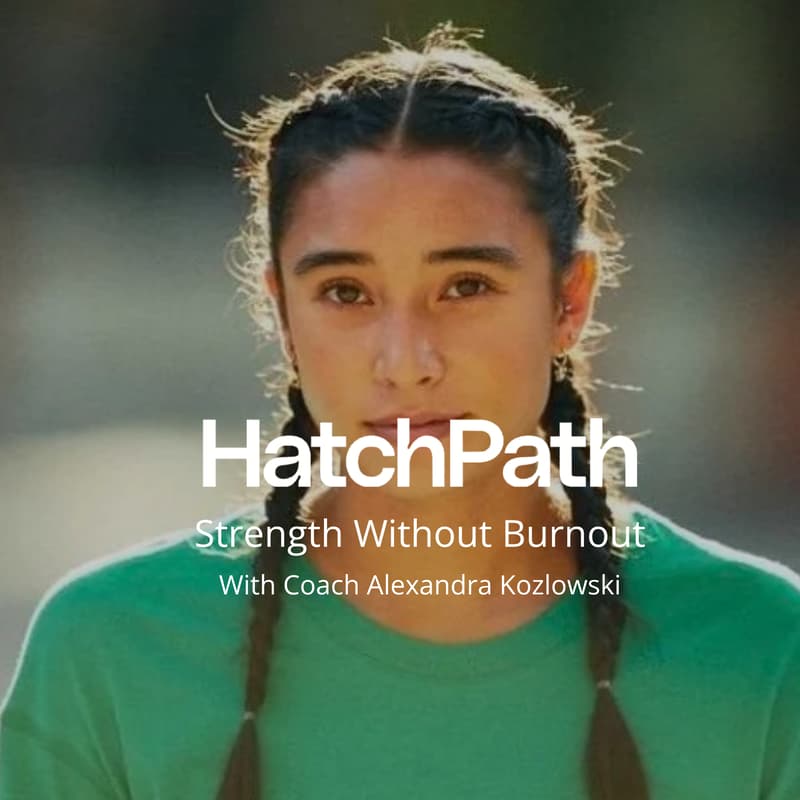

Alexandra Kozlowski
Health & Wellbeing Coach · D1 Athlete · Certified Strength & Conditioning Coach
🎙️ Listen to the Full Episode
If you've ever trained hard for weeks, felt great - then suddenly found yourself exhausted, injured, or just completely over it - you've experienced what certified strength and conditioning coach Alexandra Kozlowski calls the "Push, Crash, Repeat" cycle. In our June HatchPath Summit, Alex broke down exactly why this happens, what it does to your body, and - most importantly - how to get off the cycle for good.
What Is the Push, Crash, Repeat Cycle?
The Push, Crash, Repeat cycle is one of the most common - and most misunderstood - patterns in fitness. It looks like this: you go hard, you feel the results, you push even harder, and then everything falls apart. You get injured, or sick, or so exhausted that you stop entirely. Then after a week or two of rest, the guilt kicks in and you start the whole cycle over again.
According to Alex, the root causes are almost always the same three things: overtraining without adequate rest, under-fueling, and poor recovery habits - especially when it comes to sleep. And these three problems compound each other. Poor sleep impairs recovery. Under-fueling impairs sleep. Overtraining depletes the resources your body needs to repair.
"The body is incredibly adaptive," Alex said. "But adaptation requires a stimulus - and then recovery. If you only provide the stimulus and skip the recovery, you're just breaking down without ever rebuilding."
"A consistent menstrual cycle is a report card for the last 3 months of your health. If it becomes irregular after a period of intense training, your body is telling you it needs more recovery." - Coach Alex Kozlowski
The Hidden Danger: RED-S
One of the most eye-opening topics Alex covered was RED-S - Relative Energy Deficiency in Sport. This syndrome happens when you're consistently burning more energy than you're taking in. It was originally identified in female athletes as the 'Female Athlete Triad,' but research now confirms it affects athletes of all genders.
RED-S can lead to stress fractures, low iron, hormonal disruption, and menstrual cycle irregularities. It suppresses immune function, impairs cognitive performance, and significantly increases injury risk. The dangerous part: many people experiencing RED-S feel like they're performing well - until they suddenly aren't.
- Early signs: persistent fatigue that doesn't resolve with rest, increased frequency of minor illnesses, mood disturbances, difficulty concentrating
- Skeletal signs: stress fractures, decreased bone density, joint pain disproportionate to training load
- Hormonal signs: irregular or absent menstrual cycles, low libido, reduced testosterone in men
- Performance signs: plateau or decline despite consistent training, increased recovery time, loss of strength
The 3 Foundations of Sustainable Fitness
1. Sleep Is Your #1 Recovery Tool
Sleep is the single most important lever for recovery and performance. During deep sleep, your body releases human growth hormone - the primary driver of muscle repair and adaptation. It consolidates motor learning (making new movement patterns stick), restores glycogen stores, and recalibrates stress hormones.
Skip sleep and you're training on a foundation that keeps cracking. Even one night of poor sleep measurably reduces strength output, reaction time, and decision-making quality. Chronic sleep restriction - sleeping 6 hours or less for weeks - produces the same cognitive impairment as 24 hours without sleep, but people stop noticing the decline because they adapt to feeling impaired.
- Avoid screens 1–2 hours before bed to prevent blue light from disrupting melatonin production
- Keep your room cool (65–68°F / 18–20°C) - core body temperature must drop to initiate deep sleep
- Finish eating at least 2 hours before bed - digestion raises core temperature and fragments sleep
- Build a quiet pre-bed routine: reading, meditation, gentle breathing - consistency trains your nervous system to expect sleep
- Get direct sunlight on your eyes first thing in the morning to anchor your circadian rhythm and improve sleep quality that night
2. Fuel Your Body Like It's Doing Real Work
Under-eating is one of the most common mistakes Alex sees - especially among high achievers who apply the same "do more with less" mindset to their nutrition that they apply at work. But your body is not a startup running lean. It is a biological system that requires real inputs to produce real outputs.
Protein is the non-negotiable. Muscle protein synthesis - the process of building and repairing muscle - requires adequate dietary protein, and most active people are significantly under-consuming it. Alex recommends 0.7–1g of protein per pound of bodyweight for people engaged in regular strength training.
- Eat enough total calories - chronic caloric restriction while training is one of the most reliable ways to drive RED-S
- Prioritize protein: 0.7–1g per pound of bodyweight, distributed across meals rather than loaded into one
- Time carbohydrates around training: consume them before and after sessions when they'll be used for fuel and recovery
- Don't fear fat - dietary fat supports hormone production, joint health, and the absorption of fat-soluble vitamins critical for athletic function
- Hydrate consistently: even mild dehydration (1–2%) measurably reduces strength, endurance, and cognitive performance
3. Train Smart: The 80/20 Rule
This is perhaps the most counterintuitive principle Alex shared: 80% of your sessions should be low-intensity (Zone 1 and 2 heart rate), with only 20% at high intensity. This is the training distribution used by elite endurance athletes across virtually every sport - and the science behind it is compelling.
Zone 2 training - where you can hold a conversation but are working - builds your aerobic base, trains fat oxidation, improves mitochondrial density, and creates the cardiovascular foundation that makes all higher-intensity work more effective. High-intensity training without an adequate aerobic base is like building the upper floors of a building without the foundation.
"Most recreational athletes do the opposite," Alex said. "They make every session a hard session because hard feels productive. But the research is clear: that approach leads to overtraining, plateau, and injury. The magic is in the easy days being truly easy."
The Role of Strength Training for Longevity
Muscle mass is one of the strongest predictors of long-term health outcomes - more than BMI, more than cardiovascular fitness alone. Sarcopenia (age-related muscle loss) begins in your 30s and accelerates after 60. Resistance training is the only proven intervention to slow or reverse it.
Alex's recommendation: 2–3 strength sessions per week, focusing on compound movements (squat, hinge, push, pull, carry), with progressive overload built in. "You don't need to train like a powerlifter. You just need to consistently provide a stimulus that challenges your muscles - and then recover from it."
Why a Coach Changes Everything
A coach provides an objective lens - someone who can see what you can't see when you're inside the system. They help you define your "why" - the deeper reason behind your goals - which is what keeps you going when motivation dips. They design programming that creates the right stimulus without exceeding recovery capacity. And they help you navigate the inevitable setbacks without catastrophizing or quitting.
"The biggest thing a coach does," Alex said, "is help you play the long game. Anyone can train hard for 6 weeks. The goal is to still be training, feeling good, and making progress 10, 20, 30 years from now. That requires a fundamentally different relationship with your body than the Push, Crash, Repeat cycle allows."
Alexandra Kozlowski is a D1 athlete, certified running coach, and strength and conditioning specialist with HatchPath. She works with clients on sustainable fitness programming, injury prevention, nutrition strategy, and building a relationship with their body that lasts a lifetime.