Workplace Wellbeing & ADHD: The Invisible Cost of Masking and What Actually Helps
A HatchPath Podcast Breakdown with Coach Bec Symonds
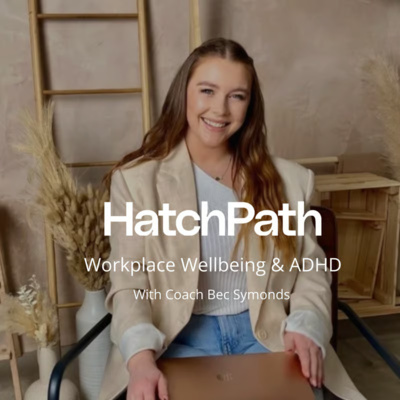

Bec Symonds
Mindset & Hypnotherapy Coach · PhD Researcher in Organisational Psychology · HatchPath
🎙️ Listen to the Full Episode
ADHD is not what you think it is. And the name is part of the problem. In this conversation with Jordan Dunin on the HatchPath Podcast, I reframe ADHD from the ground up: it is not an attention deficit. It is a regulation disorder. The difficulties span attention, emotion, and energy, and the capacity for hyperfocus alone proves that 'deficit' is the wrong word entirely. Here is a breakdown of what we covered, why masking is more draining than any task on your desk, and what actually helps neurodiverse employees thrive at work.
ADHD Is a Regulation Disorder, Not a Deficit
The first reframe I offer is the most important one. ADHD is a regulation disorder. The difficulties span attention, emotion, and energy, and they show up as executive function deficits that affect task completion, planning, and memory. The label 'attention deficit' is an oxymoron when you consider that the same person who cannot focus on paperwork can hyperfocus for hours on something that genuinely matters to them. That capacity for hyperfocus is proof that this was never about a deficit of attention. It is about the regulation of it.
"ADHD is a regulation disorder, not a deficit. Its name is an oxymoron given the capacity for hyperfocus. The difficulties span attention, emotion, and energy." Bec Symonds
This reframe matters because it changes the question. Instead of asking why someone cannot pay attention, we start asking what conditions help them regulate attention, emotion, and energy. That shift is where real support begins.
Masking: The Hidden Energy Drain
Masking is what happens when someone with ADHD hides their struggles to appear capable. Over-preparing. People-pleasing. Staying late. Double-checking everything twice. It looks like diligence from the outside, but inside it is running on fear, the fear of being perceived as less competent.
And it is a major energy drain. The behaviors themselves are not the problem. The problem is the fear driving them, and the fact that none of it is sustainable. Masking leads straight to burnout, and most of the people around the masker never see it coming because the surface performance looked so together.
The driver underneath masking is almost always a lack of psychological safety. When employees hear things like 'isn't everyone a little ADHD?' they decide immediately that it is not safe to be honest, and the mask goes on. Psychological safety is not a perk. It is the precondition that determines whether people can stop masking and start performing.
"Masking is an inauthentic persona built on fear driven by a lack of psychological safety. It is a significant energy drain leading to burnout." Bec Symonds
Masking vs. 'Fake It 'Til You Become It'
There is a critical distinction between masking and 'fake it 'til you become it' that most people miss. Masking is an inauthentic persona you build to fit in, driven by fear. 'Fake it 'til you become it' is a positive belief system you use to step into a desired identity.
One drains you. The other grows you. The difference is not in the behavior on the surface. It is in what is driving the behavior underneath. If the driver is fear of being found out, it is masking. If the driver is a belief in who you are becoming, it is growth.
Meaningful Work Is the Engagement Driver
Here is where the conversation moves from problem to solution. Meaningful work is one of the primary engagement drivers for ADHD individuals. When tasks align with personal values, like human connection or contribution, focus sustains itself. When they do not, procrastination and disengagement take over.
This means the question for a leader is not 'why isn't this person performing?' It is 'does this person's work connect to something that matters to them?' Often the gap in performance is really a gap in meaning. Close the meaning gap and a lot of the regulation issues start to resolve on their own.
The Walt Disney Matrix: When Everything Feeds One Purpose
Jordan shared a concept from his own journey that captured this principle beautifully. He calls it the 'Walt Disney Matrix': a synergistic business model where all ventures support a central purpose. When he dissolved his disparate businesses to focus entirely on HatchPath, it created a powerful, reinforcing loop where everything he did fed one central purpose.
The lesson generalizes. When the work in front of you is genuinely aligned with what matters to you, attention regulates itself. You stop fighting your brain to focus on the wrong things, and you start pouring the same energy into the work that was always trying to come through.
Why a Formal Diagnosis Matters
I make a clear case for pursuing a formal diagnosis when ADHD is suspected. Not as a label, but as a pathway to self-compassion. Understanding that your brain works differently, not brokenly, reduces the self-criticism that most people with ADHD carry for years before they ever get answers.
A diagnosis also has practical impact. It unlocks workplace accommodations and educational support. It gives you a framework for understanding your own patterns instead of blaming yourself for them. And it opens the door to honest conversations with the people around you, conversations that were impossible while you were still masking.
"A formal diagnosis provides self-compassion and access to support. It provides a framework for understanding struggles, reduces self-criticism, and enables open communication." Bec Symonds
The Leader's Question That Changes Everything
For leaders, the shift I offer is a single question. Stop asking 'why isn't this person performing?' and start asking 'what conditions will help this person perform at their best?' That single question is the difference between a workplace that drains neurodiverse talent and one that lets it thrive.
Creating psychological safety is how you operationalize that question. When it is safe to be honest about how your brain works, masking comes down, energy returns, and the capacity that was being spent on hiding becomes available for the work itself.
"Stop asking 'why isn't this person performing?' and start asking 'what conditions will help this person perform at their best?' That is the question that changes everything." Bec Symonds
What to Do Next
- If you suspect you may have ADHD, pursue a formal diagnosis to gain self-compassion and access to support
- Notice where you are masking and ask whether the driver is fear or a belief in who you are becoming
- Time-block your personal time to align your actions with your stated values, as Jordan plans to do
- Leaders: create a psychologically safe environment so your people can be honest about neurodiversity
- Focus on creating the conditions that help people thrive rather than diagnosing why they are struggling
Bec Symonds is a mindset coach and hypnotherapist with HatchPath, holding a bachelor's in Applied Psychology, a master's in Clinical and Health Psychology, and ongoing PhD research in Organisational Psychology at Alliance Manchester Business School. Book a session with Bec at hatchpath.io/CoachBecSymonds or start your HatchPath journey at hatchpath.io.